 Blastscore
Blastscore wallet scoring for project access and compatibility
Blastscore wallet scoring is designed to support project eligibility decisions through S.C.O.R.E., a rating of on-chain participation. Project rules determine how that rating applies to access. Its multi-chain design does not confirm support for every wallet application. Quest points and Proof-of-Yield have separate requirements; live scoring and campaign access remain unconfirmed.
Score-based access, quest participation, and Blast attestations
A score-based project role follows the partner's reputation criteria; Proof-of-Yield qualification combines a reputation prerequisite with Blast L2 deposits. Quest participation adds another engagement measure through bXP points earned from Blast Hub's BH Quests. Blast Hub's anti-bot design uses S.C.O.R.E. to restrict bot access to campaigns that require experienced users. Proof-of-Yield certification is also described as providing access to quest and reward opportunities.
How does a project turn S.C.O.R.E. into access requirements?
A partner project defines selection conditions and can adapt scoring parameters to reflect the participation that its product requires. Parameters shape the reputation assessment. Selection conditions determine how the project uses that assessment when offering a benefit.
Potential benefits include project roles, governance participation, and partner rewards. Each benefit belongs to the project offering it. A rating that satisfies one project's requirement does not establish eligibility elsewhere, because another partner can seek different participation or apply different conditions.
Which wallet history can contribute to the assessment?
The model considers transactions, application involvement, voting, and other ecosystem interactions, with a particular focus on engagement within Blast L2. Its multi-chain design also incorporates participation across other blockchains to give a broader account of wallet activity. That scope concerns reputation assessment, while individual access requirements can remain specific to Blast.
Value committed on Blast and yield-related activity belong to the wallet profile that the protocol was designed to analyze.
A deposit criterion for Proof-of-Yield specifically concerns deposits to Blast L2. Activity recorded on another chain can provide reputation context without satisfying that particular network requirement.
Network coverage and wallet-application support answer different compatibility questions. Coverage concerns the history that the model evaluates. Application support concerns how a service accesses a wallet. A multi-chain scoring design alone does not establish support for every wallet application's connection method.
A current wallet-application list and complete supported-network list remain unconfirmed. This uncertainty leaves particular combinations unresolved; it does not establish that activity outside Blast is excluded.
Balance size and transaction quantity within the rating
S.C.O.R.E. balances its parameters through non-linear relationships, so a large value in one category does not ensure a high final rating. The design prioritizes engagement quality and diversity over transaction quantity, including attention to transaction timing and patterns resembling bot farming. Buying additional NFTs or deploying a purposeless contract does not provide a direct way to increase reputation. For score-based eligibility, a raw activity total cannot replace the rating that the project requires.
Proof-of-Yield deposit tiers and reputation prerequisites
Proof-of-Yield recognizes activity on Blast L2 through a reputation prerequisite and deposit-based attestation tiers. The published general rule requires S.C.O.R.E. above 50 points and says attestation is unavailable otherwise. Its Proof-of-Humanity tier lists 50 S.C.O.R.E. points plus a minimum 0.1 ETH deposit to Blast L2, so eligibility at exactly 50 points is unclear. Blasted lists at least 1 ETH deposited. The published Proof-of-Yield scheme lists at least 5 ETH deposited to Blast L2 as the deposit criterion for Blasted Guru. Unblastable lists at least 10 ETH deposited.
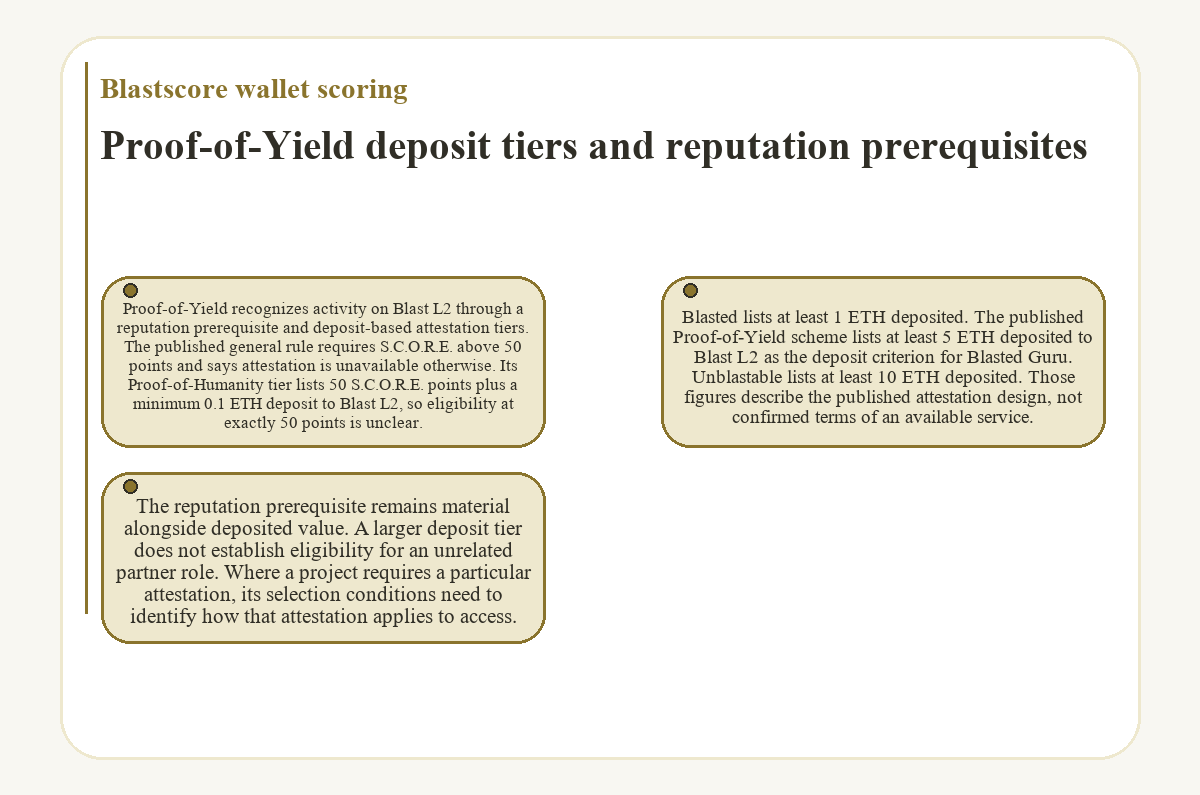
Those figures describe the published attestation design, not confirmed terms of an available service. The reputation prerequisite remains material alongside deposited value. A larger deposit tier does not establish eligibility for an unrelated partner role. Where a project requires a particular attestation, its selection conditions need to identify how that attestation applies to access.
When can a wallet proceed with a score-based eligibility check?
A wallet can proceed with a score-based eligibility check when a usable rating and the project's applicable selection conditions are available. For a wallet seeking a reputation-based role, the scoring assessment supplies a numerical value for comparison with those conditions. Meeting the score requirement satisfies that part of eligibility; any additional partner requirements remain relevant to selection.
- Identify whether the opportunity requires S.C.O.R.E., quest participation, a Proof-of-Yield attestation, or a combination of these before comparing the wallet's activity.
- Continue with a score-based assessment when the required rating is available and accepted under the project's conditions.
- If Proof-of-Yield is required, check its reputation rule and Blast L2 deposit tier; the published rules disagree at exactly 50 S.C.O.R.E. points.
- Wait when a usable rating or applicable selection terms are unavailable; elapsed time alone establishes no change in eligibility.
- Stop treating a quest-point balance as satisfying a requirement that specifically names S.C.O.R.E.
Check the project's selection outcome separately from the wallet's score. Satisfying a reputation condition does not by itself confirm the offered role or reward. Current live scoring and campaign access remain unconfirmed, as does the time needed for a project to grant a role or reward.
Public wallet history and the limits of activity attestation
Public on-chain history makes wallet participation visible to anyone inspecting those records. Using that participation for access decisions connects a project's conditions with the activity recorded for the address. Public visibility concerns the transactions themselves; it does not make every proprietary scoring weight transparent. A reputation assessment can use public inputs while relying on the team's own processing infrastructure.
Proof-of-Yield is designed to help recognize Blast participation and reduce bot intrusion into applications. Its tier criteria describe participation requirements. They do not establish a real-world identity check or protection against every form of unauthorized wallet access.
Project admission compared with personal wallet activity review
Personal activity review seeks an understanding of wallet participation, whereas project admission seeks access under a partner's conditions. The protocol's activity-review design includes inspecting one's participation and comparing wallet activity. That task can be useful without a role or reward being offered. Admission additionally requires a relevant opportunity and satisfaction of its selection terms.
Blastscore wallet scoring: reader questions
Does a project role obtained through S.C.O.R.E. specify a reward amount?
A project role obtained through S.C.O.R.E. does not itself specify a reward amount. The project defines the benefit and its allocation conditions. A reputation level describes wallet participation; calculating a reward requires a separate allocation rule specifying what the project offers.
Are Proof-of-Yield deposit thresholds fees payable to Blastscore?
The ETH thresholds describe deposits to Blast L2 within the published Proof-of-Yield tier scheme. They state deposited value as an eligibility input, rather than a payment to the scoring protocol. Those figures alone do not establish the cost of a wallet assessment or attestation; current charges remain unconfirmed.
Will changing wallets preserve a project's eligibility decision?
A replacement wallet cannot be assumed to inherit the original wallet's reputation or project eligibility. The scoring model evaluates wallet activity, while score-transfer and cross-wallet linking support remain unconfirmed. Continued eligibility would need a rule that recognizes the replacement wallet, rather than relying on the original address's selection.
How quickly can recorded activity change a project's access decision?
An eligibility decision follows the project's selection conditions, with no confirmed fixed delay after a wallet transaction. The scoring design describes real-time activity analysis, which is separate from granting a role or reward. Current live scoring availability remains unconfirmed.
Do project quests have to consist entirely of on-chain actions?
Blast Hub's quest design allows Web2 interactions alongside on-chain tasks. These tasks concern participation in a project's campaign, and task completion does not automatically satisfy a separate wallet-reputation requirement. The relevant conditions determine which task types count toward the opportunity. Current access to the quest tools remains unconfirmed.
Is failing a reputation requirement evidence that a wallet is a bot?
Failing a reputation requirement does not by itself establish that a wallet is a bot. The model examines activity patterns associated with bot farming, and it also links lower ratings to insufficient on-chain data.
Last updated: